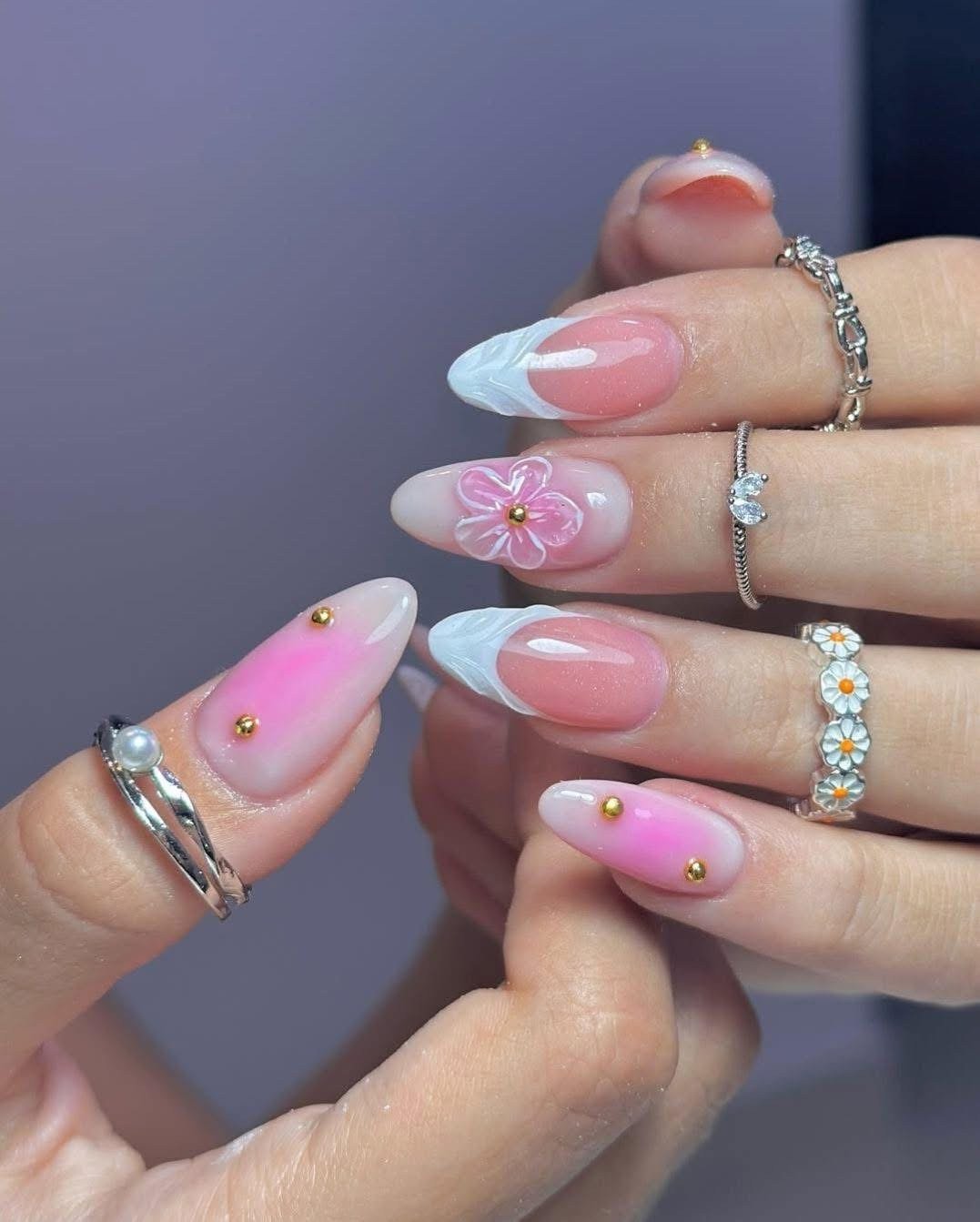
There is a particular quality of light in early April — something between winter's last silver and the full warmth of May — that changes how color reads on the hand. A blush pink that looked demure in February suddenly carries weight. A sage green that felt quiet in March becomes a statement. Easter, for all its pastel associations, is not a holiday that demands softness. It demands intention.
At Le Salon Doré, the spring nail menu is built on a principle borrowed from ikebana: restraint reveals beauty. Where lesser salons pile on rabbit silhouettes and speckled egg patterns — designs that expire the moment brunch ends — we design nails that honor the season without becoming costumes for it.
The Argument for Elevated Pastels
Pastel is not a synonym for childish. The lavenders worn by Empress Eugénie, the celadon glazes of Goryeo dynasty ceramics, the muted roses in Monet's garden at Giverny — these are pastels with centuries of sophistication behind them.
The technical challenge is in the formula. A cheap pastel polish is chalky, opaque, flat — it absorbs light rather than collaborating with it. What Tiffany works with is different. Our gel formulations suspend micro-pigments in a medium that allows light to pass through the first molecular layer before reflecting. The result is depth. A lavender that shifts between cool and warm depending on angle. A mint that carries an almost imperceptible shimmer, like dew on new leaves.
The shapes that carry pastels best this season: soft almond and medium coffin. Both provide enough surface area for the color to develop its full range without overwhelming the hand's natural architecture.
Botanical Line Work: The Anti-Sticker
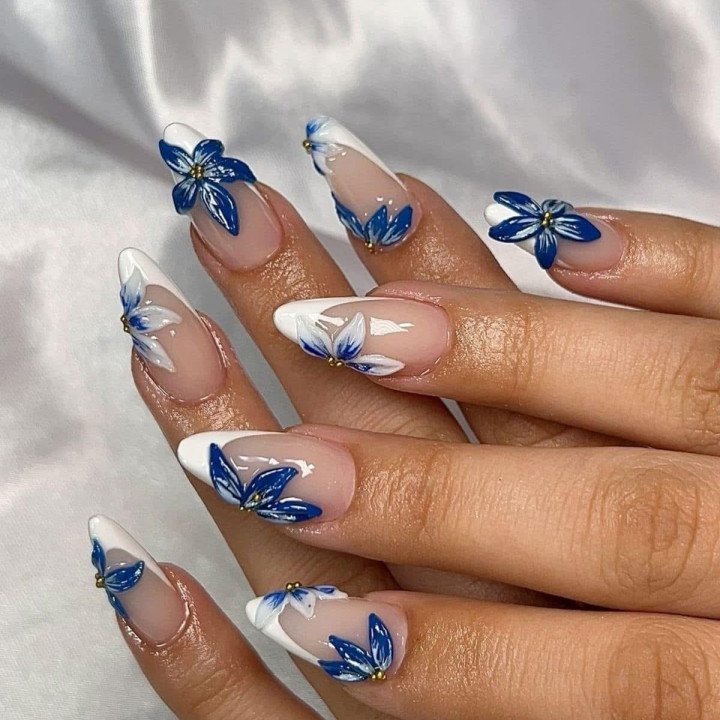
There is a world of difference between a flower sticker pressed onto a nail and a flower drawn onto one. The sticker is uniform, mechanical, immediately legible. The hand-painted line has breath in it — the slight variation in stroke width that separates illustration from decoration.
Our spring botanical work draws from Japanese sumi-e technique: the brush is loaded once, and the stroke must be completed in a single gesture. No correction, no layering. The cherry blossom branch that appears on an accent nail is five strokes. The wisteria vine is seven. Each one is unrepeatable, which is precisely the point.
This is nail art that rewards the second look. From across a table, the nails read as elegant pastels with subtle detail. Up close, the craftsmanship reveals itself.
Soft Chrome and the Light Problem
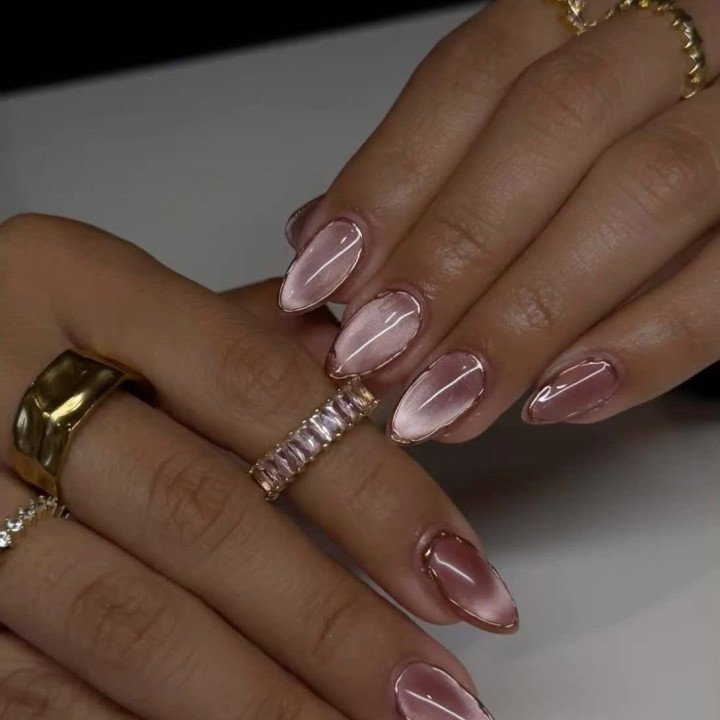
Chrome finishes have dominated nail trends for three consecutive seasons, but the Easter iteration requires restraint. A full mirror chrome in rose gold reads as holiday party, not spring garden. The answer is what the industry calls a "velvet chrome" — a finish that splits the difference between metallic reflection and matte absorption.
The science is in the particle size. Traditional chrome powders use particles in the 1-5 micron range, creating a mirror effect. Our spring chromes use a blend that includes particles in the 10-20 micron range, producing a softer, more diffused reflection. Think of the difference between a polished mirror and brushed brass.
Applied over a base of champagne, soft gold, or barely-there pink, the effect is luminous without being loud. It catches light the way silk does — not demanding attention, but earning it.
The French Reimagined
The classic French manicure is the navy blazer of nail design: always appropriate, rarely exciting. For Easter, we rebuild it.
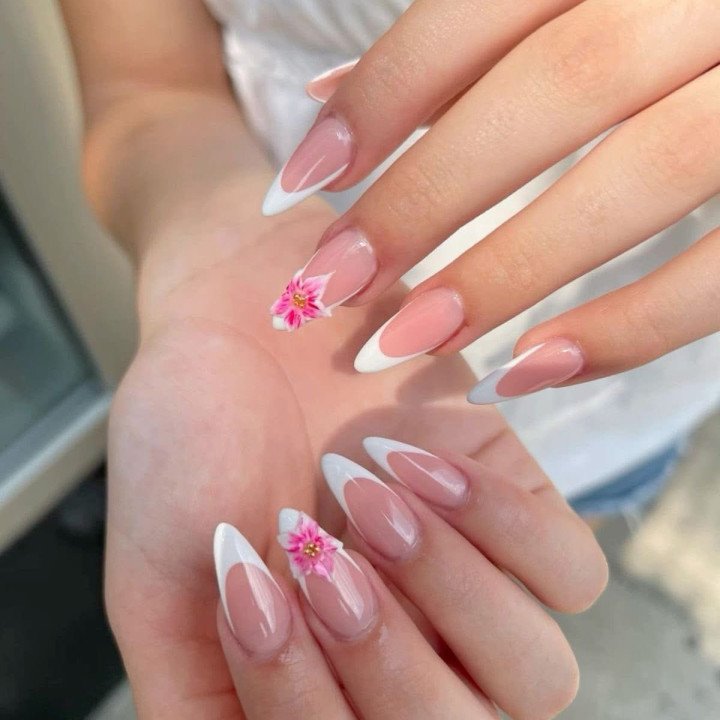
The tip line moves from stark white to a whisper of color — the palest lilac, the faintest sage, a blush so subtle it might be the natural nail bed showing through. The smile line itself becomes less geometric and more organic, following the natural curvature of the nail rather than imposing a rigid arc.
What makes this work technically is the gradient. Rather than a hard line between base and tip, Tiffany builds a micro-ombré zone — perhaps two millimeters wide — where the colors meet. It requires a steady hand and the patience to build the transition in three passes rather than one. The result is a French manicure that looks like it grew that way.
Negative Space and the Confidence It Requires
The most sophisticated Easter nail may be the one that shows the most skin. Negative space designs — where portions of the natural nail are left bare within the design — carry an ease that fully painted nails cannot replicate.
A single painted arc across a bare nail. A half-moon at the cuticle in pale rose with the rest left natural. Thin parallel lines in sage and gold running vertically, with bare nail visible between them. These designs require nails in excellent condition — healthy, buffed, even in tone — because the natural nail becomes part of the composition.
This is where Le Salon Doré's emphasis on nail health pays dividends. The CND treatments, the keratin-infused base coats, the cuticle conditioning that happens at every visit — all of it builds toward the moment when a client's natural nail is beautiful enough to be the canvas and the art simultaneously.
Timing and the Three-Week Window
Easter falls on April 20th this year. The ideal booking window for Easter nails opens now. A session booked the week of April 7th allows the design to mature — gel reaches its most luminous state around day four — while still looking pristine through Easter Sunday and the week of events that often follows.
For bridal parties doubling Easter weekend with wedding events, we recommend booking a consultation two weeks ahead. The design conversation — shape, palette, any custom botanical work — happens best when it is unhurried.
The afternoon light in Palo Alto in mid-April does something particular to pastel nails. It warms them from underneath, as though the color is not sitting on the surface but rising from within the nail itself. It lasts only an hour or so — that window between three and four o'clock when the shadows are long but the light is still generous. Tiffany calls it the best quality control tool in the salon.
It is also, not incidentally, the best time to photograph your nails for the only audience that matters: yourself, weeks from now, scrolling back through your photos and pausing on a hand that looked exactly right.
Reserve your session at Le Salon Doré — 530 University Ave, Suite A, Palo Alto.